Embroidery machines cannot usually stitch an ordinary image file such as a JPG, PNG, or PDF directly onto fabric. These machines need a special embroidery file that contains instructions for needle movements, stitch types, thread changes, and other important details. One of the most widely used formats for these instructions is the DST file.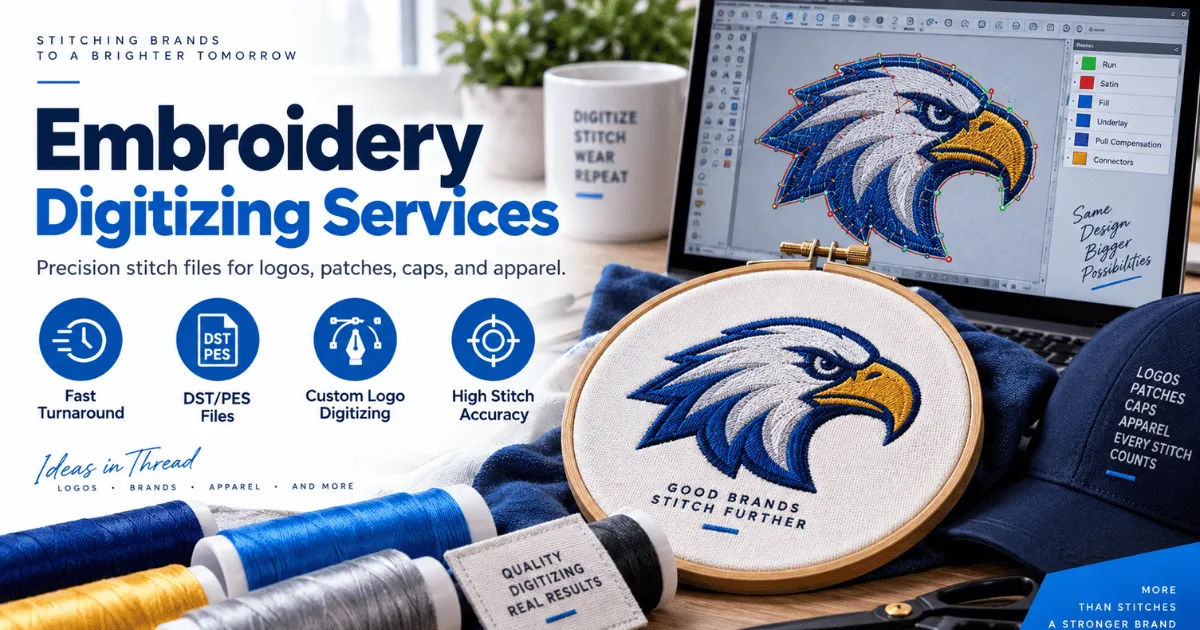
If you have a logo, artwork, name, or other design that you want to embroider, you may wonder whether an embroidery digitizing company can create a DST file for you. The answer is yes. Creating machine-ready embroidery files is one of the main services provided by professional digitizing companies.
A professional digitizer takes your artwork and converts it into a digital stitch pattern. The process involves much more than simply changing the file extension. The artwork must be carefully planned so that an embroidery machine can reproduce it accurately on the selected material.
DST is one of the most common formats used for commercial embroidery machines. However, creating a good DST file requires knowledge of embroidery techniques, stitch settings, machine requirements, fabric behavior, and thread management.
What Is a DST File?
DST stands for Data Stitch Tajima. It is an embroidery digitizing company file format originally associated with Tajima embroidery machines and has become one of the most commonly recognized formats in the embroidery industry.
A DST file contains information that tells an embroidery machine where to move its needle. It can include stitch coordinates, jump movements, stops, and other basic machine instructions.
Unlike a normal image file, a DST file does not primarily describe an image using pixels. Instead, it represents a sequence of embroidery movements.
For example, a logo may look simple when viewed on a computer screen. Once converted into embroidery, however, the machine needs precise instructions about how every section should be stitched.
This is why digitizing is an important part of the embroidery process.
Can an Embroidery Digitizing Company Create DST Files?
Yes, an embroidery digitizing company can create DST files from many types of artwork.
Customers commonly submit JPG, PNG, PDF, AI, EPS, or other graphic files. The digitizer studies the artwork and determines how it should be recreated using embroidery stitches.
The professional then creates a digital embroidery design using specialized digitizing software. After the design is completed, it can be exported into the DST format when required.
The resulting file can then be loaded onto a compatible embroidery machine.
However, simply producing a DST file does not automatically mean the embroidery will look good. The quality of the digitization is extremely important.
Two DST files created from the same artwork can produce very different embroidery results if they were digitized using different stitch settings and techniques.
Why Is DST So Common in Embroidery?
DST has remained popular because it is widely supported by commercial embroidery equipment.
Many embroidery businesses use machines that recognize DST files. This makes the format convenient when customers need designs that can work with professional embroidery equipment.
Another reason is its simplicity. DST focuses on stitch movement information rather than storing a complete visual representation of the artwork.
This makes it practical for embroidery production.
However, DST has limitations. It does not preserve all the design information that may exist in a modern editable embroidery project. Details such as certain thread colors may need to be interpreted separately depending on the software and machine being used.
For this reason, a digitizer may keep the original working file in addition to delivering the requested DST file.
How Does the DST Digitizing Process Work?
1. Artwork Submission
The process usually begins when a customer provides artwork.
The artwork might be a company logo, sports emblem, mascot, lettering design, illustration, or another graphic.
High-quality artwork is helpful because it allows the digitizer to understand shapes, outlines, colors, and proportions more accurately.
However, professional digitizers can often work with low-resolution artwork as well.
2. Artwork Evaluation
The digitizer examines the artwork before converting it into stitches.
This stage is important because embroidery has different limitations from printing.
Very small text may not remain readable after stitching. Extremely thin lines may disappear. Tiny spaces can close together because of thread thickness.
The digitizer must therefore decide which details should remain and which may need adjustment.
3. Choosing Stitch Types
Different areas of a design require different stitch types.
Satin stitches are often useful for borders, lettering, and narrow shapes. Fill stitches can cover larger areas. Running stitches can be used for fine lines and small details.
The digitizer selects the appropriate stitch type for each section.
This is one of the reasons professional digitization is more complicated than simply tracing an image.
4. Setting Stitch Direction
Stitch direction can have a major effect on the appearance of an embroidered design.
A digitizer decides how stitches should flow through different parts of the artwork.
Changing stitch direction can help create visual texture and improve the appearance of shapes.
It can also help manage how fabric reacts to the stitching.
5. Setting Stitch Density
Stitch density refers to how closely stitches are placed together.
Too few stitches can leave gaps or make the design appear weak. Too many stitches can make the embroidery overly dense, stiff, or bulky.
A skilled embroidery digitizing company considers the design, fabric, thread, size, and intended application when choosing appropriate density.
6. Adding Underlay
Underlay stitches are placed beneath the main embroidery in many designs.
They help stabilize the fabric and create a foundation for the visible stitches.
Without appropriate underlay, some embroidered areas may look uneven or fail to cover the fabric properly.
The type and amount of underlay depend on the design and material.
7. Managing Stitch Order
The order in which sections are embroidered matters.
A professional digitizer arranges the stitching sequence to reduce unnecessary jumps, minimize thread changes, and improve the overall appearance.
Proper sequencing can also help reduce registration problems.
8. Creating the DST File
After the design has been digitized, the embroidery project can be exported into the requested machine format.
If DST is required, the digitizer exports the design as a DST file.
The file can then be prepared for production on a compatible embroidery machine.
Does Every Embroidery Design Need a DST File?
Not necessarily.
DST is extremely common, but embroidery machines use several different formats.
Other formats include PES, JEF, EXP, VP3, HUS, and machine-specific formats.
The correct format depends on the embroidery machine being used.
For example, a home embroidery machine may require a different format from a commercial machine.
Therefore, customers should tell the digitizer which machine they plan to use before requesting the final file.
If you already know your machine model, providing that information can help an embroidery digitizing company select the most appropriate format and settings.
What Information Should You Give the Digitizer?
Providing accurate production information can improve the final result.
Start by explaining the required embroidery size.
A design intended for a small shirt chest area may need different digitizing decisions from the same design intended for a large jacket back.
You should also provide the type of garment or material whenever possible.
Cotton, denim, caps, jackets, fleece, performance fabrics, and other materials can behave differently during embroidery.
It is also useful to explain where the design will be placed.
A cap, sleeve, chest, bag, and jacket back may each require different approaches.
If you need a specific thread color, mention that as well.
Finally, tell the digitizer which machine and file format you need.
Can a DST File Be Made From a JPG?
Yes.
A JPG can be used as the starting artwork for digitization.
However, a JPG itself is not an embroidery file.
The digitizer must interpret the image and recreate its important elements using embroidery stitches.
For simple logos, this process may be relatively straightforward.
Complex artwork can require considerably more work because the digitizer must decide how to reproduce gradients, textures, fine details, outlines, and small shapes.
The quality of the original JPG can also affect the process.
A clear, high-resolution image generally makes it easier to identify the intended design.
Can a DST File Be Made From a PNG?
Yes.
PNG files are also commonly accepted as artwork for embroidery digitization.
Transparent backgrounds can be particularly useful because they may make the design easier to isolate from surrounding areas.
However, transparency does not automatically make a PNG ready for embroidery.
The image still needs to be converted into an appropriate stitch structure.
The digitizer must determine stitch types, density, direction, sequencing, and other settings.
Is the DST File Ready to Use Immediately?
A properly prepared DST file may be ready for production, but testing is still recommended.
Embroidery is affected by several physical factors that cannot always be predicted perfectly on a computer screen.
Fabric stretch, stabilizer selection, thread tension, needle condition, machine settings, and hooping can all influence the final result.
For important commercial orders, a test stitch-out can be valuable.
A test allows the embroiderer to identify issues before producing a large quantity of garments.
Why Testing a DST File Matters
A design can look excellent on a computer but produce unexpected results on fabric.
For example, small lettering may become difficult to read.
A narrow satin column may become too thin.
A large filled area may cause excessive fabric distortion.
Some details may also become crowded after stitching.
Testing helps identify these problems.
A professional embroidery digitizing company may make adjustments after reviewing a stitch-out or receiving feedback from the production team.
This is particularly important for logos that will be embroidered repeatedly for uniforms, merchandise, promotional clothing, or branded products.
What Makes a High-Quality DST File?
A good DST file should do more than simply contain the correct artwork.
It should be designed for the actual embroidery application.
Important characteristics include suitable stitch density, logical stitch sequencing, appropriate underlay, clean outlines, manageable jump stitches, and accurate proportions.
The design should also consider the material on which it will be embroidered.
Good digitization balances appearance with production efficiency.
An overly complicated design may contain unnecessary stitches and take too long to sew.
On the other hand, simplifying the design too much can cause important visual details to disappear.
The goal is to create a practical embroidery design that produces a clean result.
Can an Embroidery Digitizing Company Edit an Existing DST File?
Sometimes.
Editing a DST file can be more complicated than editing the original embroidery project.
DST files contain stitch information, but they may not preserve all of the original editable design elements.
For example, changing the size, stitch density, lettering, or individual objects may be easier when the original working file is available.
If you need major modifications, ask the digitizer whether they can edit the existing DST or whether the design should be recreated.
An experienced embroidery digitizing company can assess the file and determine the most practical approach.
Can DST Files Be Resized?
Yes, but resizing embroidery files should be done carefully.
Increasing or decreasing the dimensions of a stitch file does not automatically create a correctly digitized design at the new size.
When a design changes size significantly, stitch density and other settings may need to be adjusted.
Small lettering may require different stitch structures.
Large designs may need different coverage and sequencing.
This is why professional resizing often involves more than pressing a scale button.
For major size changes, redigitizing may produce better results than simply enlarging or shrinking the existing stitch file.
How Does a Professional Company Ensure Accuracy?
Professional digitizers use embroidery-specific software to build and inspect designs.
They can view stitch paths, stitch counts, sequencing, density, and other technical information.
Many professionals also simulate how the design will sew before exporting the final machine file.
This helps identify potential problems.
Some businesses also provide a preview image or production sample for approval.
Communication between the customer and digitizer is important throughout this process.
Clear instructions about size, material, colors, placement, and machine format can reduce mistakes.
What Should You Look for in a Digitizing Company?
When choosing an embroidery digitizing company, do not focus only on price.
Look at the company's experience with the type of embroidery you need.
A provider that specializes in logos may be a good choice for business branding.
Someone experienced with caps may understand the special challenges of curved surfaces.
Likewise, detailed artwork may require a digitizer with strong experience in complex designs.
Ask whether revisions are included.
It is also useful to find out whether the company can provide multiple machine formats if your production setup changes.
Most importantly, consider the quality of the actual embroidery rather than judging the service only by the digital preview.
Common Mistakes With DST Files
One common mistake is assuming that any DST file will work equally well for every situation.
Another mistake is using the same digitization settings for different fabrics.
A design created for stable cotton may not behave the same way on stretchy performance fabric.
Ignoring design size is another problem.
A logo digitized for a large jacket back may not work properly when reduced to a small shirt chest logo.
Customers may also overlook testing.
Skipping a sample stitch-out can be risky when producing hundreds of garments.
Finally, converting a design without proper digitization can produce poor stitch quality even though the file technically opens on the embroidery machine.
Benefits of Getting a DST File Professionally Digitized
Professional digitization can save time and reduce production problems.
A skilled digitizer understands that embroidery is both a digital and physical process.
The design must look correct on screen, but it must also sew correctly on fabric.
Professional digitization can improve stitch quality, readability, consistency, and production efficiency.
It can also reduce unnecessary stitches and machine movements.
For businesses producing branded clothing, a properly digitized DST file can help maintain consistent results across multiple production runs.
PSA Digitizing provides professional embroidery digitizing services for customers who want to turn their artwork, logos, and creative designs into stitch-ready files. As an experienced embroidery digitizing company, the team works with formats such as DST, PES, and JEF to accommodate different embroidery machines. Based in Clarkston, Georgia, USA, PSA Digitizing combines technical knowledge, creative skills, and modern digitizing software to produce accurate embroidery designs.
Quality and customer satisfaction remain important parts of the service. With a 4.5+ star rating on Trustpilot, PSA Digitizing has gained recognition among embroidery businesses and individual users looking for reliable digitizing assistance. From custom logos and patches to complete machine embroidery files, the company aims to make the process straightforward and stress-free. Visit psadigitizing.com when you are ready to have your artwork converted into embroidery.
Conclusion
Yes, an embroidery digitizing company can absolutely create DST files. In fact, producing machine-ready embroidery files is one of the central services offered by professional digitizers.
A DST file contains the stitch instructions required by compatible embroidery machines. However, creating a useful DST file involves much more than converting an image into a different file extension.
The artwork must first be analyzed and converted into an embroidery-friendly structure. The digitizer chooses stitch types, stitch directions, densities, underlay settings, and stitch sequences. These decisions influence how the finished embroidery looks and how efficiently it can be produced.
The design's final size and the type of material also matter. A logo intended for a cotton shirt may require different settings from one intended for a cap, jacket, bag, or stretchy garment.
Although JPG and PNG files can be used as starting artwork, they are not embroidery files themselves. A professional digitizer transforms the visual artwork into a stitch-based design and then exports it into a format such as DST when required.
It is also important to remember that a DST file should ideally be tested before large-scale production. Computer previews are useful, but fabric behavior, stabilizer, thread tension, needles, and machine settings can influence the final result.
Choosing an experienced embroidery digitizing company can therefore make a significant difference. A professional provider understands how to balance visual accuracy, stitch quality, production speed, and fabric behavior.
If you need a DST file for a commercial embroidery machine, provide the digitizer with your artwork, desired dimensions, fabric type, placement, thread requirements, and machine information. These details allow the digitizer to create a more suitable production file.
Ultimately, a DST file is not simply a converted picture. It is a carefully planned set of embroidery instructions. When those instructions are professionally created, your artwork has a much better chance of becoming clean, durable, and attractive embroidery.
The best approach is to treat digitization as an important part of the embroidery process rather than as a simple file conversion. With proper planning, professional digitization, and testing, a DST file can provide a reliable foundation for high-quality embroidered products.